DNA to RNA to Protein
Genes are regulated, transcribed, processed, translated, modified, and organized into functional cellular networks.
Molecules, Genes & Cellular Systems
The study of DNA, RNA, proteins, gene regulation, cell signaling, molecular assays, and the cellular mechanisms that connect genotype to phenotype, disease, and therapy.


Abstract
Molecular biology explains how genetic information is stored, regulated, copied, repaired, expressed, and translated into cellular function. It forms the foundation for modern diagnostics, genomics, biotechnology, drug discovery, cancer biology, infectious disease testing, and personalized medicine.
Genes are regulated, transcribed, processed, translated, modified, and organized into functional cellular networks.
Signaling pathways, transcription factors, epigenetic marks, and feedback loops control cellular behavior.
Molecular assays identify pathogens, mutations, biomarkers, drug targets, inherited risk, and treatment response.
Parts I-II
Molecular biology integrates chemistry, genetics, cell biology, biochemistry, and systems biology to explain how cells store and use biological information.
DNA polymerases copy genomic information with proofreading, repair, and replication fork control.
RNA polymerase and transcription factors convert selected genetic regions into RNA messages.
Ribosomes decode messenger RNA into amino acid chains that fold into functional proteins.
Part III
Variation in DNA sequence and gene expression can alter protein function, pathway behavior, disease risk, and therapy response.
Single nucleotide variants, insertions, deletions, copy number changes, and structural rearrangements can influence health and disease.
RNA sequencing reveals active genes, isoforms, cell states, immune signatures, and disease-associated expression programs.
Chromatin state, methylation, and histone modifications shape gene accessibility without changing DNA sequence.
Proteins interact in pathways that control metabolism, growth, immunity, repair, and cell fate decisions.
Part IV
Cells interpret signals through receptors, kinases, second messengers, transcription factors, and feedback control.
Growth factor receptors activate intracellular cascades that control cell cycle entry, survival, differentiation, and tissue repair.
Cytokines, antigen receptors, innate sensors, and checkpoint pathways coordinate immune activation and tolerance.
Cells detect DNA damage, oxidative stress, unfolded proteins, and metabolic strain through molecular surveillance systems.
Molecular circuits sense nutrients, oxygen, hormones, and energy balance to regulate cellular metabolism.
Part V
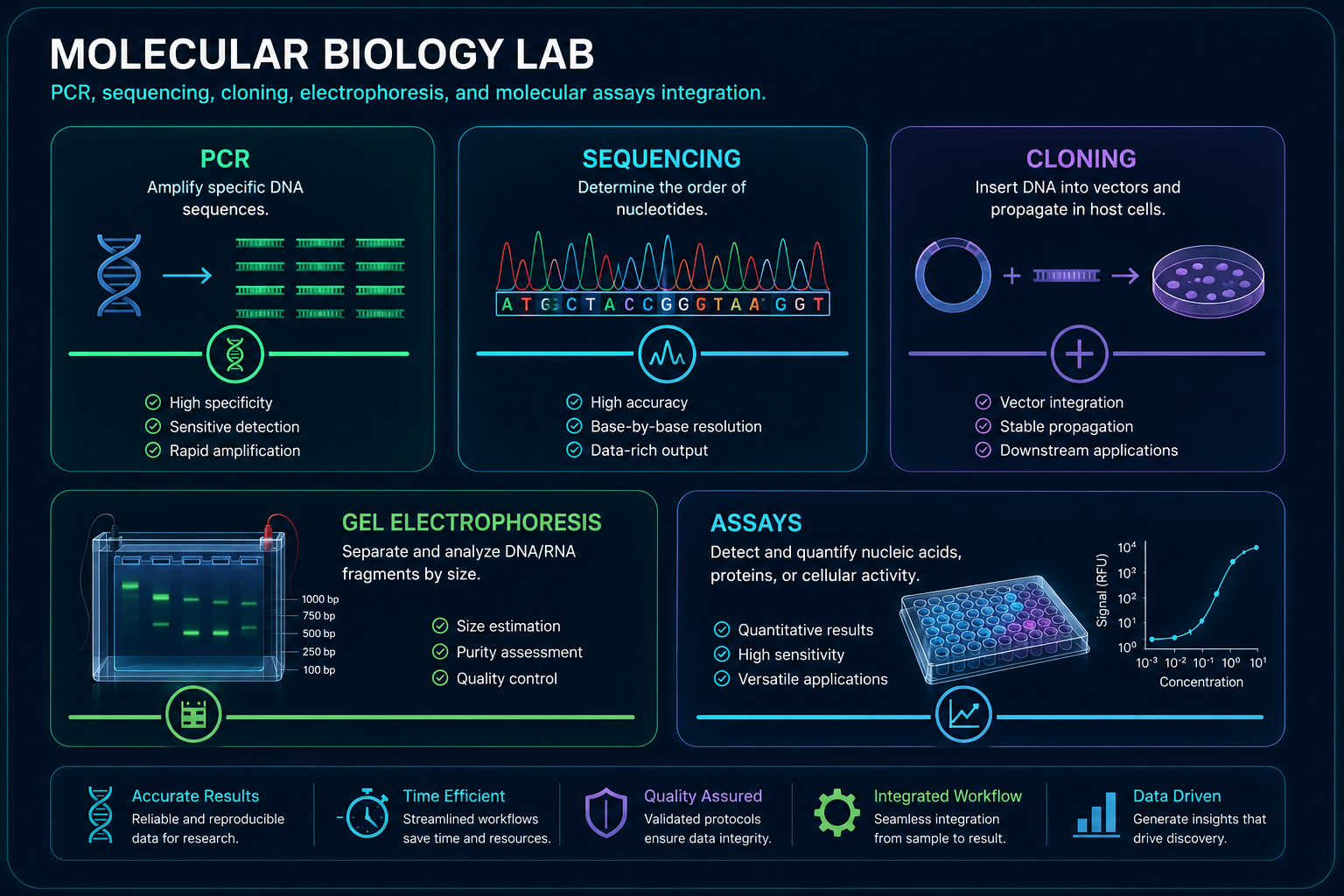
Molecular biology uses experimental methods to isolate, amplify, sequence, visualize, edit, and quantify biological molecules.
Polymerase chain reaction amplifies target DNA, while quantitative PCR measures nucleic acid abundance in real time.
Sanger and next-generation sequencing identify variants, transcripts, microbial genomes, and tumor molecular profiles.
Plasmids, viral vectors, and synthetic constructs enable gene expression, perturbation, and functional testing.
Gel systems, Southern, Northern, and Western blotting separate and detect DNA, RNA, and proteins.
Programmable nucleases and guide RNAs support genome editing, gene knockout, base editing, and functional screens.
Single-cell RNA-seq and spatial profiling reveal cell states, heterogeneity, and tissue organization.
Part VI
Molecular biology connects mechanistic science to diagnostics, therapies, vaccines, biomarkers, and public health.
Part VII
Molecular results must be interpreted with technical quality, biological context, ethics, and clinical relevance in mind.
Sample handling, contamination, sensitivity, specificity, and reproducibility can shape molecular conclusions.
Genetic variants may be pathogenic, benign, uncertain, mosaic, or context-dependent.
Sequencing and omics platforms generate large datasets requiring careful analysis and validation.
Cell state, tissue context, environment, and timing can change molecular behavior.
Genomic data raises consent, family risk, privacy, and equitable access questions.
Mechanistic findings must be tested for utility, safety, and patient benefit.
Part VIII
The future is increasingly multi-omic, spatial, programmable, and integrated with AI-driven biological modeling.
Spatial transcriptomics and proteomics map molecular activity within tissue architecture.
Genome editing, synthetic circuits, and engineered cells can reshape therapeutic development.
Machine learning supports structure prediction, variant interpretation, pathway modeling, and drug design.
Single-cell profiling may identify rare cell states, treatment resistance, and early disease transitions.
Patient-specific molecular models can simulate disease mechanisms and treatment response.
References
Alberts, B., et al. (2022). Molecular Biology of the Cell.
Watson, J. D., et al. (2014). Molecular Biology of the Gene.
National Human Genome Research Institute. (2025). Genomics and Molecular Biology Resources.
National Center for Biotechnology Information. (2025). Genes, Genomes, and Molecular Data Resources.
Doudna, J. A., & Charpentier, E. (2014). The New Frontier of Genome Engineering with CRISPR-Cas9. Science, 346(6213).
ENCODE Project Consortium. (2020). Expanded Encyclopaedias of DNA Elements in the Human and Mouse Genomes. Nature, 583, 699-710.
Stark, R., Grzelak, M., & Hadfield, J. (2019). RNA Sequencing: The Teenage Years. Nature Reviews Genetics, 20, 631-656.
Jumper, J., et al. (2021). Highly Accurate Protein Structure Prediction with AlphaFold. Nature, 596, 583-589.
FAQ
Evidence-based answers about genes, proteins, pathways, molecular assays, and precision health applications.
Molecular biology studies the molecules that control life, especially DNA, RNA, proteins, gene regulation, signaling pathways, and cellular mechanisms.
It identifies mutations, biomarkers, molecular subtypes, pathogen signatures, drug targets, and treatment-response patterns that can guide personalized care.
The central dogma describes information flow from DNA to RNA to protein, while modern biology also includes regulation by chromatin, noncoding RNA, feedback systems, and protein modification.
PCR amplifies specific nucleic acid targets, while sequencing reads DNA or RNA information to detect variants, pathogens, gene expression, and molecular disease features.
CRISPR systems can edit or regulate genes for research, functional screens, disease modeling, therapeutic development, and selected clinical applications.