Cells to Systems
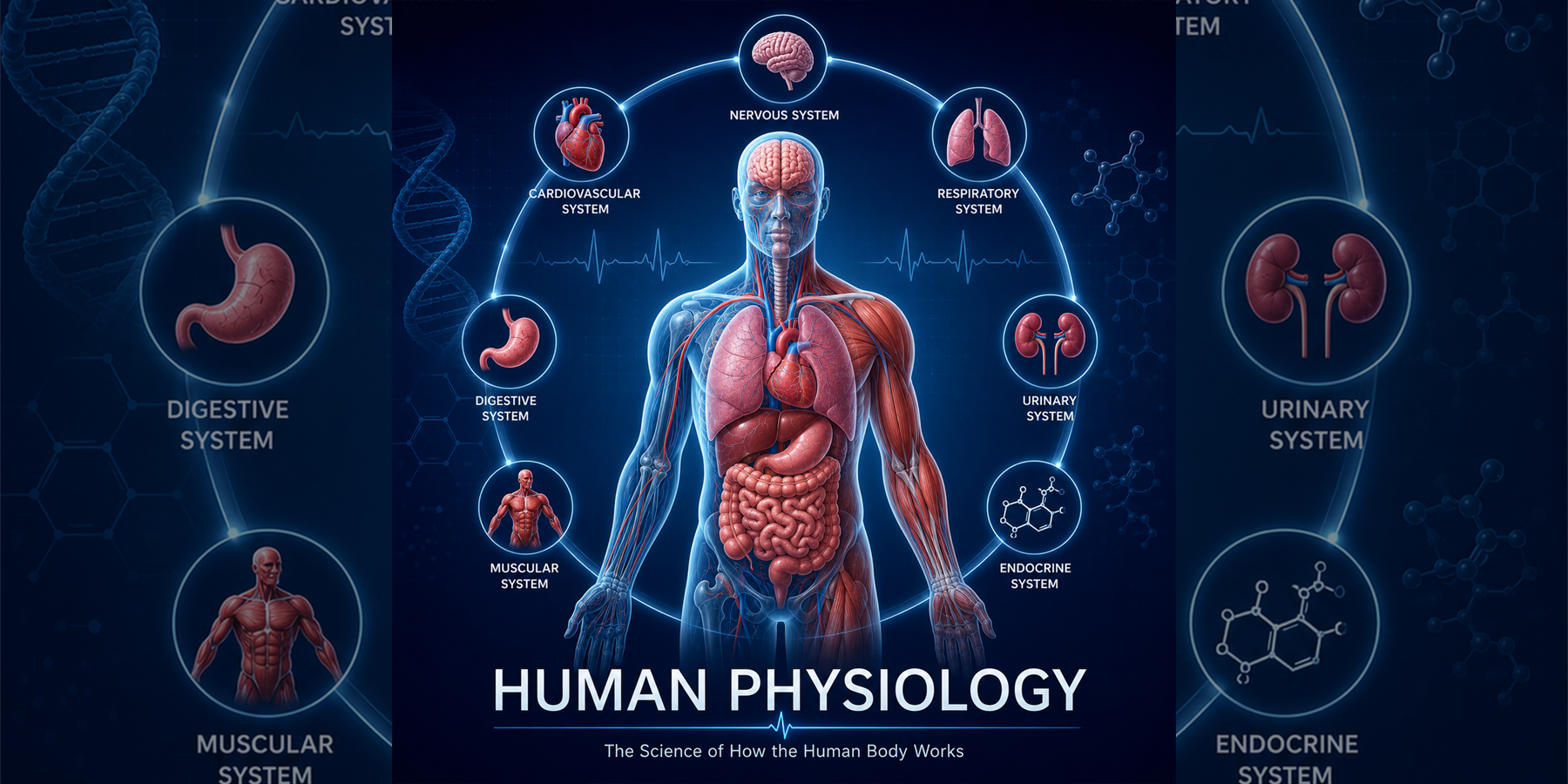
Physiology explains how cells, tissues, organs, and organ systems interact to regulate internal conditions and respond to environmental change.
Mechanisms & Regulation of Life Processes
Exploring how cells, tissues, organs, and systems work in concert to maintain life, regulate internal conditions, and respond to the challenges of a changing environment.
Abstract
Human physiology studies the normal functions of living organisms and the mechanisms by which body systems maintain life.
Physiology explains how cells, tissues, organs, and organ systems interact to regulate internal conditions and respond to environmental change.
It forms the scientific foundation of medicine, nursing, pharmacology, sports science, diagnostics, and therapeutic intervention.
Molecular physiology, genomics, medical imaging, bioinformatics, AI, and biosensors expand how clinicians understand regulation and disease.
Part I
Anatomy describes structure; physiology explains function, interaction, regulation, and adaptation.
The human body is composed of approximately 37 trillion cells working together through coordinated chemical, electrical, mechanical, and genetic processes.
Part II
The cell is the fundamental unit of life. Understanding cellular function is the basis of all physiology.
Stores genetic information and controls cell activity through gene expression and regulatory signals.
Generate ATP through oxidative phosphorylation, supporting energy-dependent physiological work.
Synthesizes proteins and lipids required for membranes, secretion, signaling, and cellular structure.
The Golgi packages cellular products; lysosomes digest waste materials and cellular debris.
Cell membranes regulate movement of ions, water, nutrients, and signaling molecules across cellular boundaries.
Sodium, potassium, calcium, and chloride gradients power nerve impulses, muscle contraction, secretion, and transport.
Cells convert nutrients into ATP through glycolysis, the citric acid cycle, and oxidative phosphorylation.
Hormones, substrate availability, oxygen supply, and gene expression adjust energy production to physiological demand.
Part III
The maintenance of a stable internal environment is the central organizing principle of physiology.
Blood glucose, thermoregulation, and blood pressure control all use feedback loops to counteract change and restore stable conditions.
Childbirth contractions and blood clotting amplify physiological responses until a specific endpoint is reached.
Part IV
The nervous system coordinates rapid electrical and chemical communication throughout the body.
The brain and spinal cord integrate sensory information and coordinate motor, cognitive, autonomic, and homeostatic responses.
Higher cognition, memory, language, and voluntary movement.
Emotion, motivation, and memory consolidation.
Motor coordination, balance, and fine movement.
Autonomic regulation, respiration, cardiovascular control, endocrine control, and homeostasis.
The PNS connects the central nervous system to the body through sensory nerves, motor nerves, and the autonomic nervous system.
Detects touch, pain, temperature, proprioception, and other sensory input.
Activate skeletal muscles for voluntary movement.
Supports fight-or-flight responses, increasing heart rate and mobilizing energy.
Supports rest, digestion, recovery, and energy conservation.
Reward, motivation, and motor control.
Mood, sleep, and appetite regulation.
Neuromuscular transmission and memory.
Primary inhibitory and excitatory neurotransmitters.
Part V
These systems deliver oxygen and nutrients to every cell while removing waste products and carbon dioxide.
Blood averages 5-6 liters in adults and carries oxygen, immune cells, platelets, hormones, nutrients, and metabolic waste.
The lungs exchange gases across roughly 480 million alveoli, with breathing regulated by brainstem centers and chemoreceptors.
Part VI
Hormones act as chemical messengers that regulate growth, metabolism, reproduction, fluid balance, and stress responses.
Produced by pancreatic beta cells, insulin lowers blood glucose and promotes glucose uptake and glycogen synthesis in liver, muscle, and adipose tissue.
Supports stress adaptation, glucose availability, immune modulation, and metabolism.
Regulate sodium, water balance, blood volume, and blood pressure.
Regulates growth, protein synthesis, metabolism, and tissue repair.
Testosterone and estrogen regulate reproductive physiology, secondary sex characteristics, bone, muscle, and metabolism.
Part VII-VIII
Body systems coordinate nutrient acquisition, waste elimination, fluid homeostasis, defense, and reproduction.
The kidneys maintain fluid, electrolyte, and acid-base balance while excreting metabolic waste through filtration, reabsorption, secretion, and excretion.
The stomach, intestine, liver, pancreas, and large intestine coordinate digestion, nutrient absorption, detoxification, and water balance.
Innate immunity provides rapid nonspecific defense, while adaptive immunity creates antigen-specific memory through B cells, T cells, and antibodies.
Female and male reproductive systems are regulated by the hypothalamic-pituitary-gonadal axis through GnRH, LH, and FSH signaling cascades.
Part IX
The body responds acutely and adapts chronically to physical exertion and environmental stressors.
High altitude, heat stress, cold exposure, and microgravity require physiological adjustments in blood, temperature regulation, tissue maintenance, and fluid distribution.
Part X
Emerging technologies are transforming physiological research and enabling precision healthcare at unprecedented scales.
Reveals mechanisms of ion channels, receptor signaling, and gene-environment interactions.
Integrates multiple physiological systems into computational models that simulate whole-body function.
Uses genomic, proteomic, metabolomic, and physiological data to personalize healthcare interventions.
Supports continuous monitoring, predictive diagnostics, disease modeling, and individualized treatment planning.
Track heart rate, blood glucose, oxygen saturation, activity, and other signals for preventive care.
Future models may simulate individual physiology for personalized diagnosis and treatment optimization.
References
Hall, J. E. (2021). Guyton and Hall Textbook of Medical Physiology (14th ed.). Elsevier.
Silverthorn, D. U. (2022). Human Physiology: An Integrated Approach (9th ed.). Pearson.
Tortora, G. J., & Derrickson, B. H. (2023). Principles of Anatomy and Physiology (16th ed.). Wiley.
Barrett, K. E., Barman, S. M., Brooks, H. L., & Yuan, J. X.-J. (2023). Ganong's Review of Medical Physiology (27th ed.). McGraw-Hill.
Cannon, W. B. (1932). The Wisdom of the Body. W.W. Norton & Company.
Bear, M. F., Connors, B. W., & Paradiso, M. A. (2020). Neuroscience: Exploring the Brain (4th ed.). Wolters Kluwer.
Vander, A. J., Sherman, J. H., & Luciano, D. S. (2019). Human Physiology: The Mechanisms of Body Function (15th ed.). McGraw-Hill.
National Institute of General Medical Sciences. (2024). Physiology and Human Health. U.S. National Institutes of Health.
Widmaier, E. P., Raff, H., & Strang, K. T. (2023). Vander's Human Physiology: The Mechanisms of Body Function (16th ed.). McGraw-Hill.
American Physiological Society. (2024). Core Concepts in Physiology and Biomedical Research.
FAQ
Evidence-based answers to common questions about body regulation, circulation, hormones, kidneys, and exercise.
Homeostasis is the maintenance of stable internal conditions. The body maintains it through feedback loops involving sensors, control centers, and effectors that regulate temperature, glucose, blood pressure, pH, and fluid balance.
The heart pumps blood through vessels to deliver oxygen, nutrients, hormones, and immune cells while removing carbon dioxide and metabolic waste.
Endocrine glands release hormones into the bloodstream to regulate metabolism, growth, reproduction, stress adaptation, blood glucose, and fluid balance.
The kidneys filter plasma, reabsorb needed water and solutes, secrete additional waste products, and excrete urine to regulate volume, electrolytes, acid-base balance, and blood pressure.
Exercise acutely increases heart rate, cardiac output, oxygen consumption, and ventilation. Chronic training improves stroke volume, mitochondrial density, capillary supply, insulin sensitivity, and resting cardiovascular efficiency.