Medicine and Society
Global health integrates medicine, public health, epidemiology, environmental science, sociology, economics, psychology, and international policy.
21st Century Challenges
Addressing the interconnected crises shaping human health across populations worldwide - from food insecurity and waterborne disease to mental health, environmental hazards, and social determinants of health.
Abstract
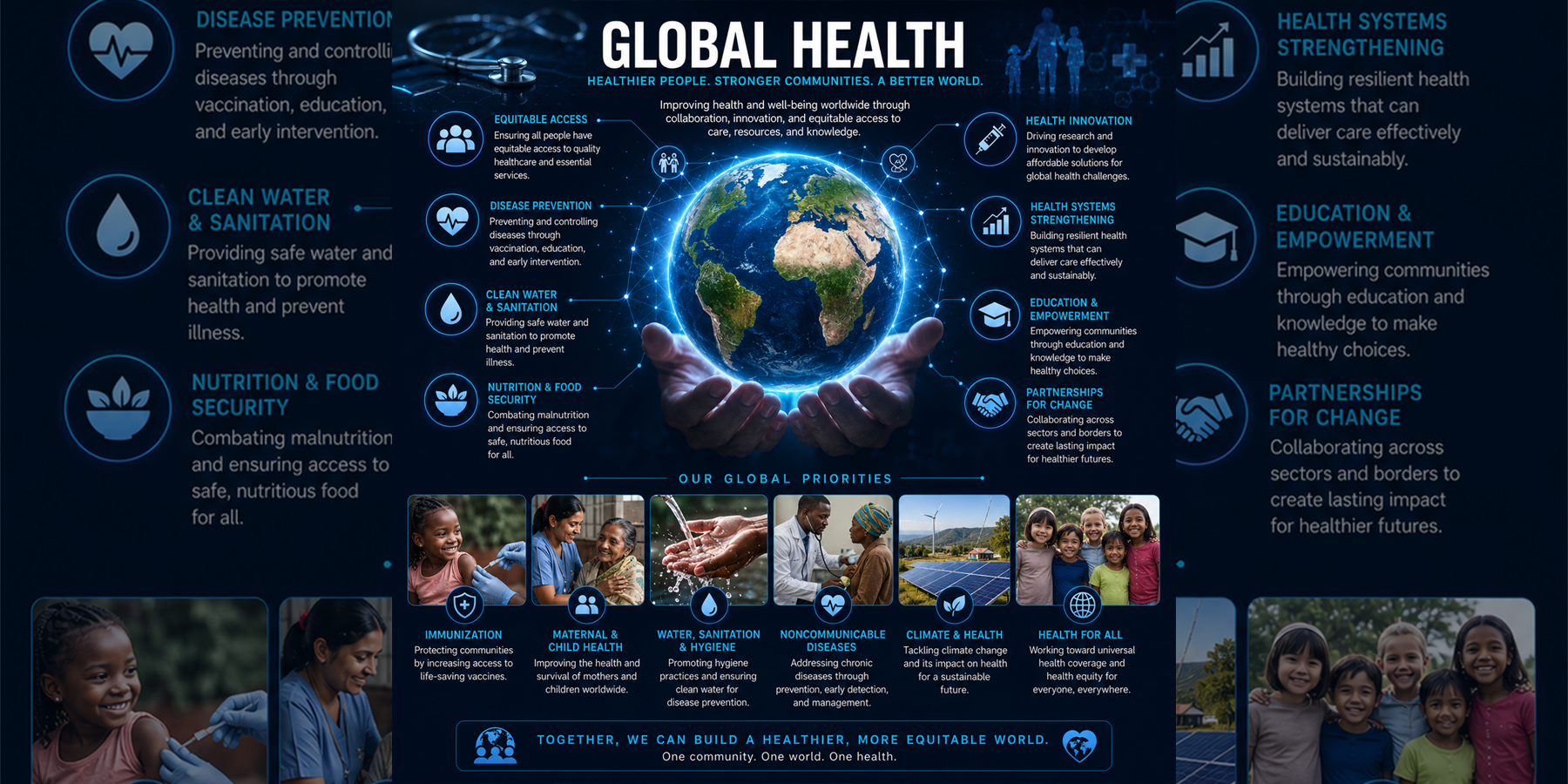
Global health focuses on improving health outcomes, reducing disparities, and promoting equitable access to healthcare across populations worldwide.
Global health integrates medicine, public health, epidemiology, environmental science, sociology, economics, psychology, and international policy.
Its central goal is reducing unjust disparities between countries, communities, and populations through evidence-based interventions.
Malnutrition, inadequate sanitation, environmental disease, depression, trauma, conflict, poverty, and climate change interact to shape health outcomes.
Part I
Global health transcends national boundaries and connects health equity with sustainable development.
Poverty, education, nutrition, environmental quality, political stability, and healthcare infrastructure strongly shape health outcomes.
Part II
The triple burden of undernutrition, micronutrient deficiencies, and overnutrition affects billions across every income level.
Insufficient caloric or protein intake results in wasting, stunting, and underweight status, especially among children under 5 in low-income settings.
Hidden hunger includes iron deficiency anemia, vitamin A deficiency, iodine deficiency, zinc deficiency, and folate deficiency.
Excess caloric intake drives obesity, overweight, type 2 diabetes, cardiovascular disease, and metabolic syndrome worldwide.
Iron-folate supplementation, antenatal counseling, and exclusive breastfeeding support infant immunity and brain development.
Food fortification, school feeding programs, biofortified crops, and smallholder support improve nutrition and education outcomes.
Part III
Inadequate water and sanitation remain among the most preventable causes of death, disproportionately affecting children in low-income countries.
Cholera, typhoid fever, dysentery, hepatitis A, Giardia, Cryptosporidium, and helminths spread through contaminated water and poor sanitation.
Handwashing, safe food preparation, improved toilets, water treatment, and menstrual hygiene management break fecal-oral transmission.
Water, sanitation, and hygiene programs yield major health and productivity gains through reduced disease burden.
Part IV
Pollution, toxic exposures, and climate change together represent a major environmental health crisis.
PM2.5, ozone, nitrogen oxides, and sulfur dioxide contribute to lung disease, cardiovascular disease, stroke, cancer, asthma, COPD, and dementia risk.
Heat illness, vector-borne disease expansion, food insecurity, mental health impacts, and water insecurity amplify existing vulnerabilities.
Environmental causes contribute to millions of deaths annually and require prevention, regulation, adaptation, and resilient health systems.
Parts V-VI
Major depression and psychological trauma are leading contributors to disability and disease burden worldwide.
Affecting more than 280 million people worldwide, major depressive disorder is a leading cause of disability, yet many people do not receive adequate treatment.
Monoamine dysregulation, HPA axis hyperactivity, neuroinflammation, reduced neuroplasticity, and genetic vulnerability.
CBT, interpersonal therapy, SSRIs/SNRIs, ketamine or esketamine, exercise, rTMS, and ECT.
Conflict, displacement, domestic and sexual violence, disasters, and childhood adversity create lasting biological and psychological effects.
Re-experiencing, avoidance, negative cognitions, and hyperarousal.
Amygdala hyperactivation, hippocampal volume reduction, prefrontal hypoactivation, and HPA axis dysregulation.
Modern healthcare increasingly shifts from "What is wrong with you?" to "What happened to you?"
Establish physical and emotional safety as the foundation of care.
Use transparency, peer support, cultural sensitivity, and restored agency to support healing.
Part VII
The conditions in which people are born, grow, live, work, and age determine a large share of health outcomes.
Poverty increases disease exposure, limits healthcare access, worsens nutrition, and creates chronic stress.
Education improves health literacy, income, decision-making, and life expectancy.
Mold, overcrowding, lead, violence, and unsafe housing drive respiratory disease, injury, mental illness, and infection.
Stable work supports health, while job insecurity and occupational hazards increase disease risk.
Strong social connections reduce mortality risk and protect mental health.
Structural racism shapes access to care, environmental exposure, chronic stress, and clinical outcomes.
Part VIII
Infectious diseases remain leading causes of global mortality and are amplified by climate change, antimicrobial resistance, and globalization.
Antiretroviral therapy transformed HIV from fatal to manageable, while testing and treatment targets continue to guide global strategy.
Drug-resistant TB is a growing crisis, and new drug regimens remain a major global priority.
Vaccines, insecticide-treated nets, and vector control remain essential prevention strategies.
Surveillance, rapid diagnostics, vaccine platforms, genomic sequencing, and One Health systems strengthen outbreak response.
Part IX
Evidence-based programs and international organizations drive progress against preventable death and disability.
Vaccines remain among the most cost-effective public health interventions, preventing millions of deaths each year.
First-1000-days interventions, food supplementation, micronutrient fortification, and maternal-child programs produce high returns.
Task-shifting, WHO mhGAP guidelines, and integrated primary care help close the global treatment gap.
WHO, UNICEF, WFP, CDC, Gavi, and MSF support surveillance, vaccines, food assistance, emergency care, and access to medicines.
Part X
Innovation, digital technology, and sustained political commitment are foundations for a healthier and more equitable world.
Combines genomics, epidemiology, and data science to target interventions to high-risk populations.
Telemedicine, mobile health, AI diagnostics, and wearable biosensors extend care to underserved populations.
Health systems must integrate heat warning, vector control, food resilience, and climate-informed disease surveillance.
Task-shifting, digital therapeutics, and community-based programs are closing treatment gaps.
Health equity requires progress in poverty reduction, girls' education, gender equality, environmental protection, and governance.
References
World Health Organization. (2024). World Health Statistics Report. WHO.
United Nations Children's Fund. (2024). The State of the World's Children. UNICEF.
World Food Programme. (2024). Global Hunger and Food Security Reports. WFP.
Marmot, M., & Wilkinson, R. (2021). Social Determinants of Health (3rd ed.). Oxford University Press.
Patel, V., Saxena, S., Lund, C., et al. (2018). The Lancet Commission on Global Mental Health and Sustainable Development. The Lancet, 392(10157), 1553-1598.
Intergovernmental Panel on Climate Change. (2023). Climate Change and Human Health Assessment Reports. IPCC.
World Bank. (2024). Water, Sanitation, and Hygiene Global Practice Reports.
Centers for Disease Control and Prevention. (2024). Global Health and Emerging Infectious Diseases Resources.
Koplan, J. P., Bond, T. C., Merson, M. H., et al. (2009). Towards a Common Definition of Global Health. The Lancet, 373(9679), 1993-1995.
United Nations Development Programme. (2024). Sustainable Development Goals Progress Report.
Institute for Health Metrics and Evaluation. (2024). Global Burden of Disease Study.
FAQ
Evidence-based answers to common questions about global health challenges, nutrition, social determinants, depression, and climate impacts.
Major challenges include infectious diseases, non-communicable diseases, malnutrition, mental health disorders, antimicrobial resistance, climate-related health impacts, and persistent health equity gaps.
Malnutrition includes undernutrition, micronutrient deficiency, and overnutrition. It can impair immunity, brain development, physical growth, reproductive health, and lifelong disease risk.
Income, education, housing, employment, social support, race, ethnicity, and neighborhood conditions shape exposure to disease, access to care, stress burden, and life expectancy.
Major depression affects hundreds of millions worldwide and is a leading cause of disability, with large treatment gaps in many countries.
Climate change increases heat illness, vector-borne disease, food insecurity, water insecurity, air pollution effects, disaster trauma, and climate-linked mental health burden.