How Are Traits Inherited?
Inheritance patterns explain how DNA variants move through families and influence physical traits, disease risk, and biological function.
DNA | Inheritance | Gene Expression | Disease | Precision Medicine
Exploring the structure, function, inheritance, variation, and regulation of genetic information - from Mendelian principles to whole-genome sequencing, CRISPR editing, and AI-driven precision medicine.
Abstract
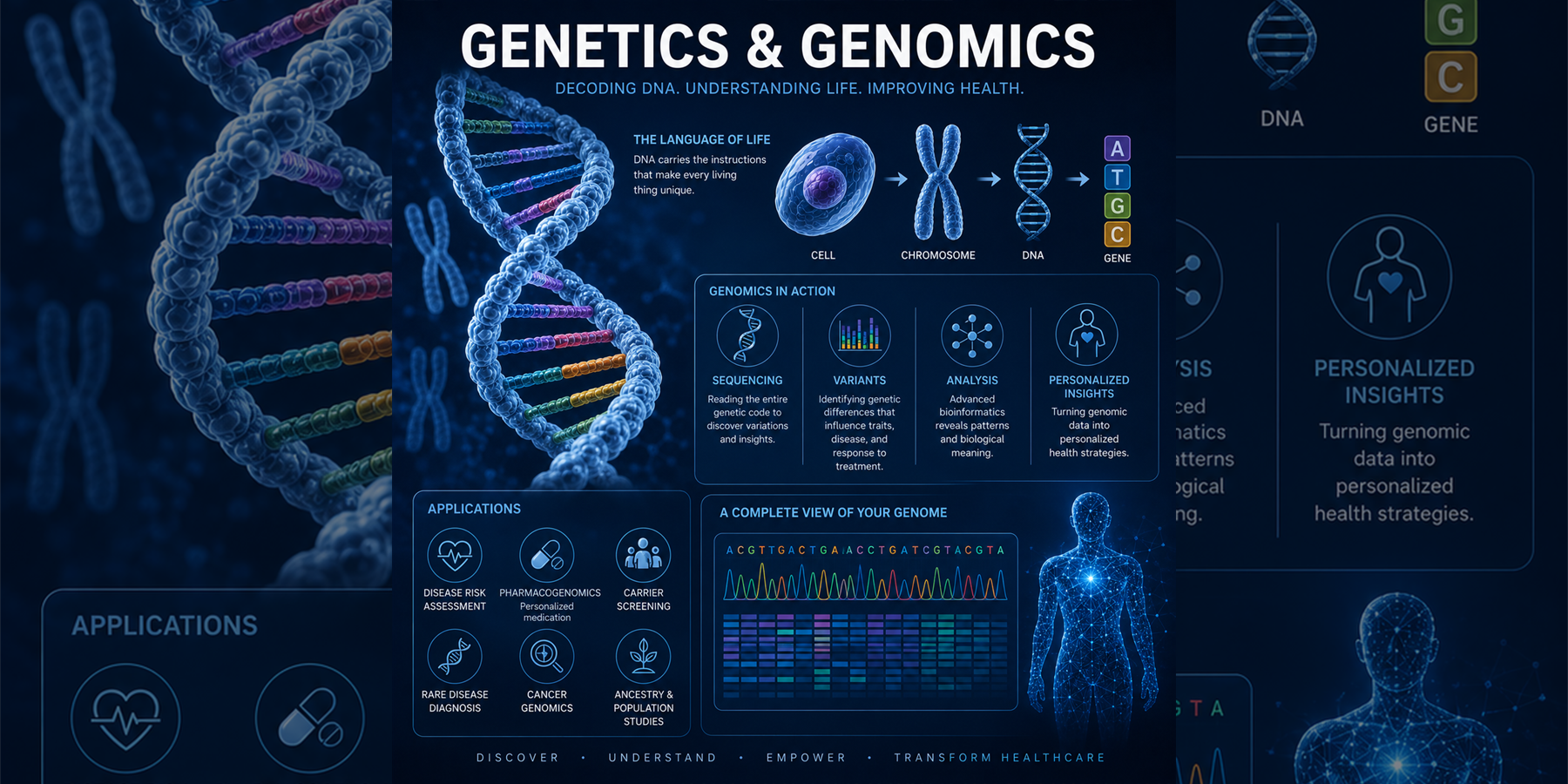
Genetics focuses on individual genes and inherited traits, while genomics studies the complete genetic content of organisms and the interactions among genes. Together, they form the backbone of modern biology, molecular diagnostics, pharmacogenomics, gene therapy, and personalized healthcare.
Inheritance patterns explain how DNA variants move through families and influence physical traits, disease risk, and biological function.
Genes encode RNA and proteins that drive metabolism, development, cell signaling, immunity, repair, and adaptation.
Pathogenic variants may disrupt protein coding, regulatory elements, chromosome structure, or gene expression timing.
Mutation, recombination, selection, drift, duplication, and structural variation reshape genomes across generations.
Genomic information improves screening, diagnosis, prevention, treatment selection, and drug dosing.
Next-generation sequencing, bioinformatics, and AI allow clinicians to interpret millions of variants at scale.
Part I
Genetics studies individual genes and heredity; genomics examines entire genomes. The two disciplines work together to explain development, traits, disease, evolution, and precision healthcare.
Part II
From Mendel's pea plants to the double helix and CRISPR, these milestones built modern genetics and genomic medicine.
Gregor Mendel's pea plant experiments established the Law of Segregation and Law of Independent Assortment.
Sutton and Boveri linked hereditary units to observable chromosomes.
Avery, MacLeod, and McCarty showed DNA carries genetic information.
Watson and Crick described the DNA double helix using X-ray data from Rosalind Franklin and Maurice Wilkins.
The complete human genome reference transformed molecular biology, disease research, and clinical genetics.
Doudna and Charpentier demonstrated programmable genome editing, enabling precise DNA modification.
Part III
Hereditary information is organized from nucleotide bases to DNA, chromatin, chromosomes, genes, and regulatory regions.
The sequence of adenine, thymine, cytosine, and guanine encodes genetic instructions. Complementary base pairing supports replication and information transfer.
Humans have 23 chromosome pairs: 22 pairs of autosomes and one sex chromosome pair, XX or XY.
Protein-coding genes produce mRNA that is translated into enzymes, receptors, structural proteins, and signaling molecules.
rRNA, tRNA, miRNA, and lncRNA regulate gene expression, translation, RNA stability, and cellular processes.
Promoters, enhancers, silencers, and insulators control when, where, and how much genes are expressed.
Repetitive DNA makes up roughly half of the human genome and includes transposons, satellite DNA, and tandem repeats.
Part IV
Cells read, process, and regulate genetic information so the right proteins are produced at the right time and place.
Sequence-specific DNA-binding proteins activate or repress gene transcription by recruiting regulatory machinery.
Methyl groups added to cytosine residues can silence gene expression and stabilize epigenetic memory.
Acetylation, methylation, and phosphorylation alter chromatin compaction and accessibility.
ATP-dependent complexes reposition nucleosomes to expose or hide regulatory DNA sequences.
miRNAs, lncRNAs, and siRNAs influence RNA stability, translation, chromatin, and gene silencing.
Heritable changes in gene expression without DNA sequence changes support development, differentiation, and adaptation.
Part V
Genetic variants drive individual differences in traits, disease risk, drug response, and inheritance patterns.
Single-base changes occur approximately every 300 bases and form the basis of many GWAS studies.
Addition or removal of nucleotides can cause frameshift mutations that alter protein coding.
Duplicated or deleted DNA segments can affect dosage and are linked to developmental and neuropsychiatric disorders.
Inversions, translocations, and rearrangements affect large genomic regions and often require long-read sequencing.
Examples include Huntington's disease, Marfan syndrome, BRCA1/2 cancer risk, and neurofibromatosis.
Examples include cystic fibrosis, sickle cell disease, Tay-Sachs disease, and phenylketonuria.
Examples include hemophilia A and B, Duchenne muscular dystrophy, color blindness, and Fabry disease.
Part VI
Genome-scale technologies read, interpret, and leverage the complete genetic blueprint of organisms.
Completed in 2003, the Human Genome Project produced the first complete reference sequence of the human genome.
WGS reads coding and non-coding regions, structural variants, copy number changes, and regulatory DNA.
Functional genomics studies how genes and regulatory elements influence cell behavior, phenotype, and disease.
About 98.5% of the human genome is non-coding, including regulatory elements, repetitive DNA, and introns.
Comparing genomes across species reveals conserved elements, evolutionary relationships, and functional pathways.
Clinical interpretation links genomic variants to evidence, phenotypes, inheritance, and treatment relevance.
Part VII
Genomic medicine has revealed the molecular causes of inherited and acquired disease.
Single-gene disorders often follow Mendelian inheritance and can be diagnosed with targeted testing, exome sequencing, or genome sequencing.
CFTR chloride channel dysfunction.
HBB beta-globin structural mutation.
HEXA lysosomal enzyme deficiency.
HTT CAG trinucleotide repeat expansion.
Cancer develops as somatic mutations disrupt cell cycle control, DNA repair, apoptosis, and growth signaling.
TP53, RB1, and BRCA1/2 loss reduces growth restraint.
KRAS, MYC, and EGFR promote constitutive proliferation signaling.
MLH1, MSH2, and POLE disruption can cause hypermutation.
BCR-ABL and EML4-ALK produce constitutively active kinases.
Common diseases often reflect hundreds of variants combined with lifestyle and environmental exposures.
TCF7L2, PPARG, and SLC30A8 variants affect beta-cell and insulin signaling.
9p21, LPA, and LDLR variants influence lipid metabolism and inflammation.
APOE4, CLU, and CR1 influence amyloid clearance and neuroinflammation.
FTO, MC4R, and LEP variants influence energy homeostasis.
Karyotyping, chromosomal microarray, and prenatal genomic testing detect large chromosomal abnormalities.
Trisomy 21 with intellectual disability and cardiac defects.
45,X with short stature and ovarian failure.
47,XXY with male hypogonadism and infertility.
22q11.2 deletion affecting cardiac, immune, and neurodevelopmental systems.
Part VIII
Precision medicine integrates genomic, biomarker, clinical, and lifestyle data to tailor prevention, diagnosis, and treatment.
Whole-genome sequencing, polygenic risk scores, and pharmacogenomic panels.
Protein, metabolite, and epigenetic markers linked to disease state and treatment response.
EHR-derived phenotypic information including diagnoses, vitals, labs, and response history.
Diet, exercise, environmental exposures, and social determinants of health.
Genotype-guided dosing can reduce bleeding complications.
Loss-of-function alleles predict inadequate platelet inhibition.
Ultra-rapid metabolizers risk toxicity; poor metabolizers may receive no analgesia.
Tumor mutational burden and microsatellite instability predict immunotherapy response.
Mandatory screening prevents life-threatening hypersensitivity.
Companion diagnostics identify CML patients with the t(9;22) translocation.
Part IX
Revolutionary technologies are reshaping medicine, research, and the ability to read and rewrite the genome.
AAV-delivered functional genes are used for disorders such as inherited retinal disease and spinal muscular atrophy.
siRNA and antisense oligonucleotides silence dominant-negative or gain-of-function mutations.
Base editors and delivery systems can correct point mutations directly in target tissues.
Examples include Zolgensma, Luxturna, Hemgenix, and Casgevy.
Part X
Responsible governance is essential as genetics and genomics move deeper into medicine, research, biotechnology, and society.
Genomic data can reveal sensitive information about individuals and biological relatives.
Large genomic databases are high-value targets because genetic data is permanent and deeply identifying.
Protections remain limited for life, disability, and long-term care insurance.
Heritable embryo modifications affect future generations and demand strict ethical oversight.
Real-time multi-omic profiles and clinical decision support will increasingly individualize healthcare.
Diverse biobanks can reveal population-specific variants and reduce genomic health disparities.
Scientific References
Alberts, B., Johnson, A., Lewis, J., et al. (2022). Molecular Biology of the Cell (7th ed.). Garland Science.
Brown, T. A. (2021). Genomes 5 (5th ed.). Garland Science.
Griffiths, A. J. F., Wessler, S. R., Carroll, S. B., & Doebley, J. (2020). Introduction to Genetic Analysis (12th ed.). W.H. Freeman.
National Human Genome Research Institute (NHGRI). (2024). Genomics and Precision Health. National Institutes of Health.
Strachan, T., & Read, A. (2018). Human Molecular Genetics (5th ed.). Garland Science.
Watson, J. D., Baker, T. A., Bell, S. P., et al. (2022). Molecular Biology of the Gene (8th ed.). Pearson.
Collins, F. S., Morgan, M., & Patrinos, A. (2003). The Human Genome Project: Lessons from Large-Scale Biology. Science, 300(5617), 286-290.
Doudna, J. A., & Charpentier, E. (2014). The New Frontier of Genome Engineering with CRISPR-Cas9. Science, 346(6213), 1258096.
Takahashi, K., & Yamanaka, S. (2006). Induction of Pluripotent Stem Cells from Mouse Embryonic and Adult Fibroblast Cultures by Defined Factors. Cell, 126(4), 663-676.
National Academies of Sciences, Engineering, and Medicine. (2020). Heritable Human Genome Editing. National Academies Press.
FAQ
Evidence-based answers to common questions about genetics and genomics.
Genetics is the study of individual genes, inheritance, and their effects on traits and diseases. Genomics is the broader study of an organism's entire genome, including genes, regulatory regions, non-coding DNA, interactions, and population-scale patterns.
CRISPR-Cas9 is a programmable gene-editing system that uses a guide RNA to direct the Cas9 enzyme to a specific DNA sequence, where it can cut or modify genetic material.
Sequencing can identify many monogenic disorders, chromosomal disorders, cancer driver mutations, pharmacogenomic variants, and rare disease causes that are difficult to diagnose with traditional testing.
Gene expression is the process by which DNA information is used to make RNA and proteins. It is regulated by promoters, enhancers, transcription factors, chromatin state, DNA methylation, histone marks, and non-coding RNAs.
The Human Genome Project produced the first reference human genome, making modern genomic medicine, comparative genomics, variant discovery, and large-scale sequencing research possible.