Biomedical Engineering
Designs devices, imaging systems, prosthetics, diagnostics, and therapeutic tools that directly improve patient outcomes.
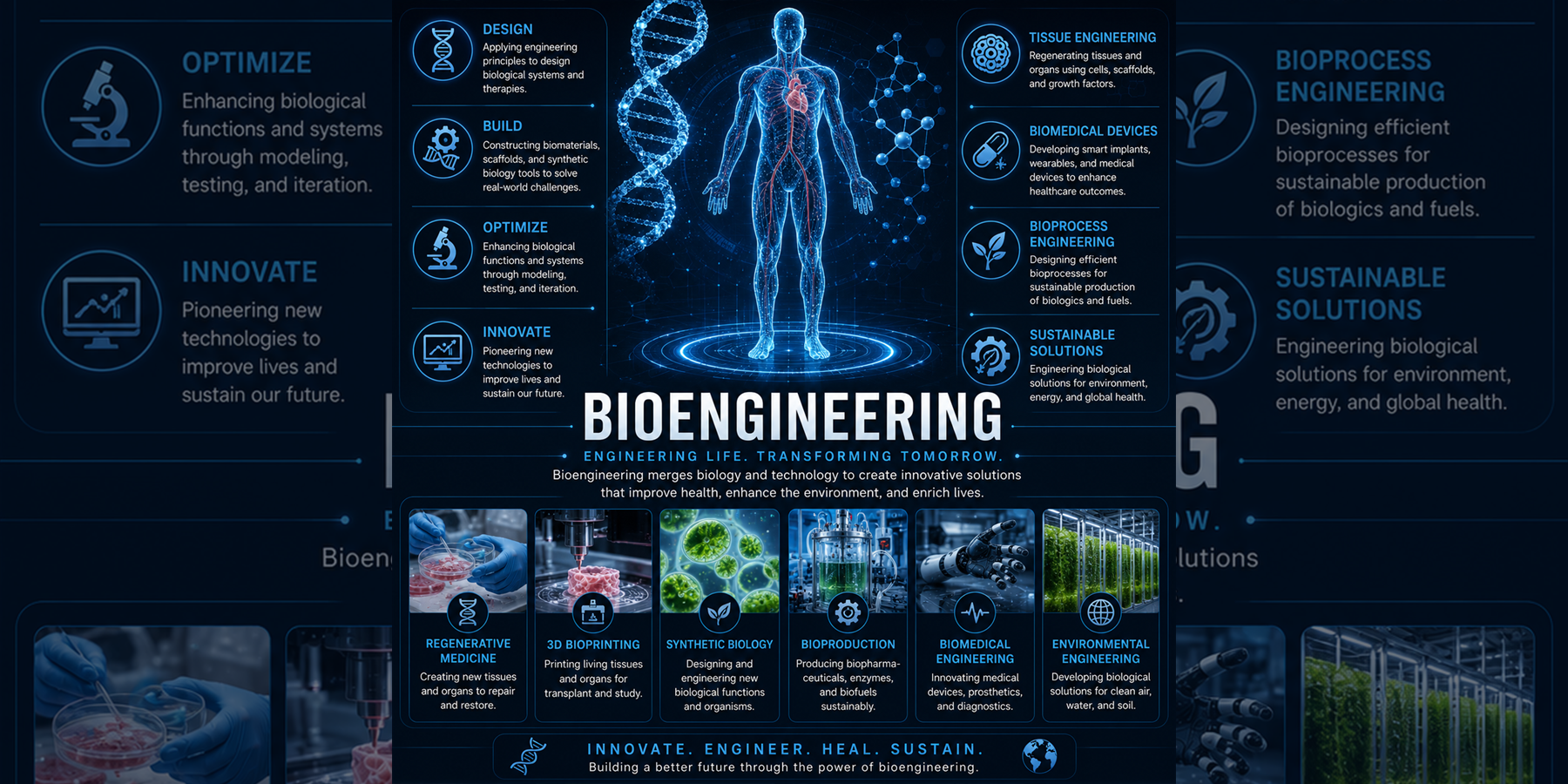
Bioengineering
Integrating Biology, Engineering & Technology
Applying engineering principles to biological systems to develop innovative solutions for healthcare, biotechnology, regenerative medicine, and personalized therapeutics.
Abstract
Bioengineering applies engineering principles, biological sciences, mathematics, physics, chemistry, and computational technologies to solve complex biological and medical problems.
Designs devices, imaging systems, prosthetics, diagnostics, and therapeutic tools that directly improve patient outcomes.
Uses tools such as CRISPR-Cas9 to modify genes, correct disease mechanisms, and engineer therapeutic cells.
Combines cells, biomaterials, scaffolds, and growth factors to create functional tissues for repair and replacement.
Builds brain-computer interfaces, neuroprosthetics, stimulation therapies, and bioelectronic medicine systems.
Uses machine learning, digital twins, systems modeling, and multi-omic analysis to guide discovery and clinical decisions.
Scales vaccines, biologics, gene therapies, cell therapies, enzymes, and engineered microbial products.
Part I & II
Bioengineering understands, modifies, and improves living systems through engineering design, quantitative modeling, and systems-level thinking.
Define the clinical or biological need before developing a technical solution.
Analyze requirements, biological constraints, safety expectations, and patient needs.
Generate candidate solutions and evaluate them against performance and clinical requirements.
Build functional models, validate performance, and test safety under controlled conditions.
Refine the design and translate the solution into patient use or industrial production.
Simulate drug absorption, distribution, metabolism, and elimination.
Predict cell proliferation, scaffold integration, and tissue maturation.
Use computational fluid dynamics to model cardiovascular hemodynamics.
Model signal propagation in nervous system circuits.
Part III
The largest branch of bioengineering develops technologies that directly improve patient outcomes and quality of life.
Electrical stimulation systems that regulate cardiac rhythm.
Devices that restore normal rhythm after cardiac arrest.
Continuous subcutaneous insulin delivery for diabetes management.
Hearing restoration through direct nerve stimulation.
Mobility restoration in degenerative joint disease.
Noninvasive imaging systems for anatomy, disease staging, and treatment planning.
Real-time imaging technology for diagnostics and guided procedures.
Image processing systems that quantify tumor volumes, tissue features, and disease progression.
Measure physiological signals continuously for monitoring and prevention.
Track internal biomarkers or device function in real time.
Detect disease biomarkers through molecular binding, optical, electrical, or nanoscale signals.
Part IV
Modifying and designing biological systems at the genetic level, from targeted edits to new cellular programs.
CRISPR-Cas9 enables precise, programmable editing of genomic sequences and expands possibilities for personalized medicine, regenerative therapies, and functional genomics.
Correct monogenic disorders such as sickle cell disease and beta-thalassemia.
Support CAR-T manufacturing and immune cell reprogramming for cancer therapy.
Synthetic biology applies modularity, abstraction, and standardization to build novel biological systems not found in nature.
Genetic toggle switches and oscillators that mimic electronic circuit logic.
Cells engineered to detect disease biomarkers or environmental toxins.
Part V
Creating functional biological tissues and organs using cells, scaffolds, and growth factors.
Combines cells, biomaterials, growth factors, and engineering scaffolds to create functional tissues for repair and replacement.
Stem cells' self-renewal and differentiation potential make them central to tissue development and patient-specific therapies.
Addresses global organ shortages through decellularization, bioprinting, organoid technology, and stem cell organogenesis.
Bioengineered skin for burn wound treatment.
Osteogenic scaffolds that guide bone regeneration.
Joint repair technologies for degenerative disease.
Engineered patches and tissue systems for heart repair.
Part VI
Materials engineered to interact with biological systems, plus nanoscale tools for precision medicine.
Tissue scaffolds, wound dressings, and drug delivery matrices.
Antimicrobial coatings, controlled drug release, and hemostasis.
Joint lubrication, dermal fillers, and wound healing hydrogels.
Hydrogel scaffolds, protein conjugation, and antifouling coatings.
Biodegradable implants, bone fixation devices, and sutures.
Long-term implants and nanofiber scaffolds for tissue engineering.
Nanoparticles selectively accumulate in tumor tissue through EPR effects and targeting ligands.
Gold nanoparticle probes and quantum dots enable ultrasensitive biomarker detection.
Lipid nanoparticles deliver siRNA and mRNA payloads directly into tumor cells.
Carbon nanotube and graphene-based sensors detect single-molecule biological analytes.
Part VII
Applying engineering principles to the nervous system for therapeutic and augmentative applications.
BCIs record neural signals and decode them in real time to control external devices or restore communication.
Paralysis rehabilitation, assistive communication, prosthetic limb control, and sensory restoration.
Bioelectronic medicine uses precisely targeted electrical stimulation to treat disease with fewer systemic side effects.
Deep brain stimulation, vagus nerve stimulation, and spinal cord stimulation.
Part VIII
Computational and AI-driven approaches are transforming biological discovery and clinical decision-making.
CNNs diagnose diabetic retinopathy, detect cancer on pathology slides, and quantify tumor volumes from MRI.
ML models predict sepsis, ICU deterioration, and readmission risk from health records before clinical recognition.
Generative AI designs drug candidates by optimizing molecular properties against target binding and ADMET profiles.
Deep learning identifies multi-omic signatures from genomic, proteomic, and metabolomic datasets.
AlphaFold2 predicts 3D protein structures from amino acid sequence with near-experimental accuracy.
Personalized computational models simulate physiology, treatment response, surgical planning, and virtual trials.
Part IX
Large-scale production of biological products that power modern medicine and industry.
Recombinant protein subunit and mRNA vaccines produced in bioreactor systems at GMP scale.
CHO cell bioreactors produce major antibody therapeutics for oncology and autoimmune diseases.
Viral vector and non-viral delivery system manufacturing for AAV and lentiviral gene correction.
Automated CAR-T and NK cell manufacturing pipelines support personalized immunotherapy.
Engineered microorganisms produce insulin, human growth hormone, artemisinin, enzymes, and biofuels.
Controlled environments manage temperature, pH, oxygen, and mixing for cell culture and microbial production.
Part X
Emerging innovations and responsible oversight will guide bioengineering into the future.
Personalized biological solutions tailored to patients using genomic, proteomic, and physiological data.
Automated design and optimization from de novo protein design to self-optimizing bioreactors.
3D bioprinting of fully vascularized functional tissues and organs to address donor shortages.
Engineered cells that sense disease biomarkers and release therapeutic molecules in place.
Advanced neuroprosthetics and bidirectional brain-computer interfaces.
Gene editing, human enhancement, synthetic biology biosecurity, AI clinical decisions, and genomic privacy.
Bioengineering represents one of the most dynamic and impactful scientific disciplines of the modern era, combining biology, engineering, and computational intelligence to create more precise, effective, and personalized therapies.
References
Saltzman, W. M. (2019). Biomedical Engineering: Bridging Medicine and Technology (3rd ed.). Cambridge University Press.
Enderle, J. D., & Bronzino, J. D. (2021). Introduction to Biomedical Engineering (4th ed.). Academic Press.
Lanza, R., Langer, R., & Vacanti, J. (2020). Principles of Tissue Engineering (5th ed.). Academic Press.
Doudna, J. A., & Charpentier, E. (2014). The New Frontier of Genome Engineering with CRISPR-Cas9. Science, 346(6213), 1258096.
Topol, E. J. (2019). High-Performance Medicine: The Convergence of Human and Artificial Intelligence. Nature Medicine, 25(1), 44-56.
Langer, R., & Tirrell, D. A. (2004). Designing Materials for Biology and Medicine. Nature, 428(6982), 487-492.
Murphy, S. V., & Atala, A. (2014). 3D Bioprinting of Tissues and Organs. Nature Biotechnology, 32(8), 773-785.
Kitano, H. (2002). Systems Biology: A Brief Overview. Science, 295(5560), 1662-1664.
National Institute of Biomedical Imaging and Bioengineering. (2024). Biomedical Engineering and Emerging Technologies.
National Academy of Engineering. (2023). Frontiers in Bioengineering and Biotechnology.