Medical Pattern Recognition
AI supports radiology, pathology, dermatology, ophthalmology, lab medicine, and high-volume screening.
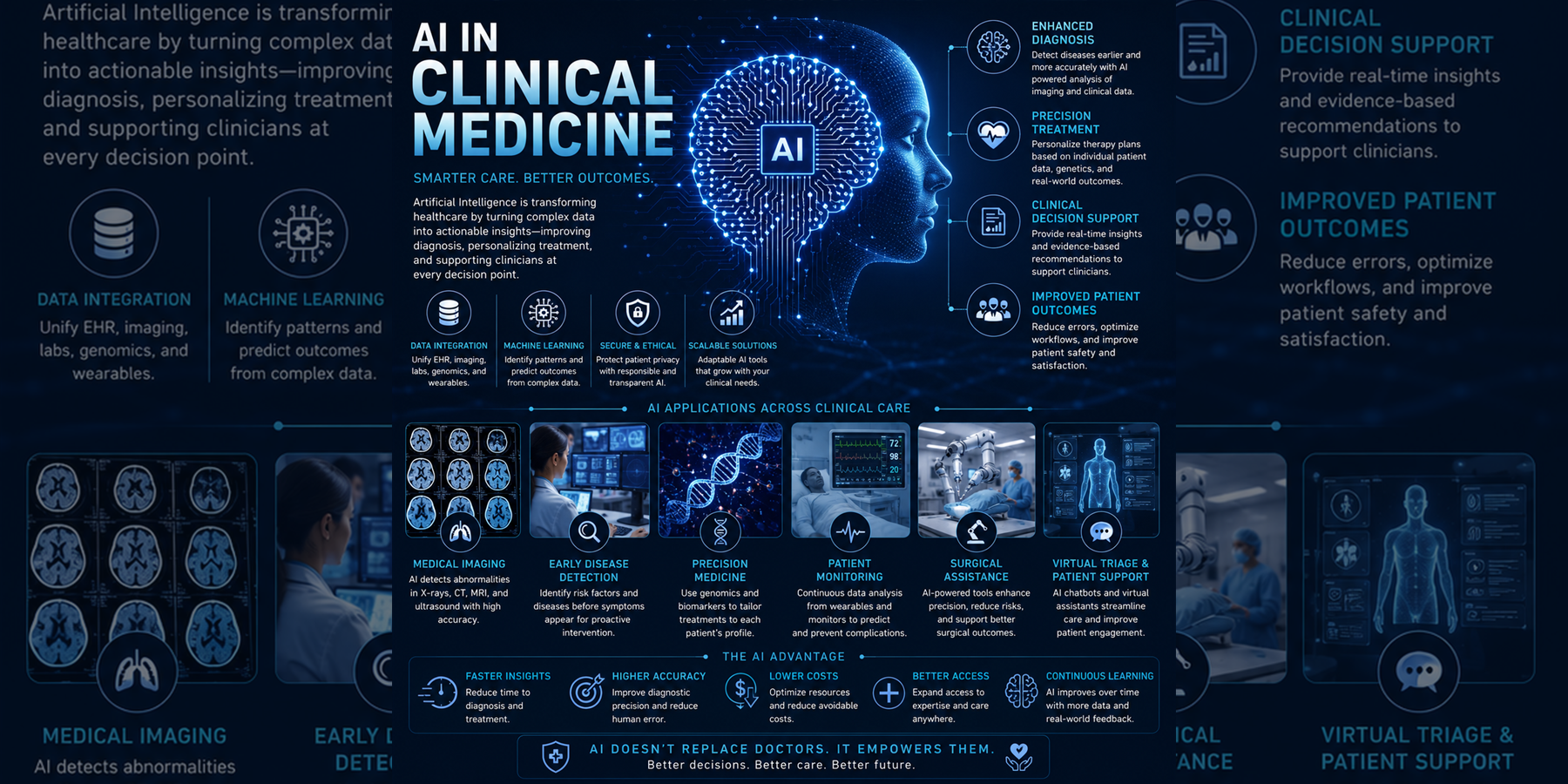
AI in Clinical Medicine
Intelligent Diagnostics, Precision Medicine & Clinical Decision Support
Integrating machine learning, deep learning, natural language processing, and computer vision to reshape clinical medicine, diagnostics, patient monitoring, and healthcare delivery.
Abstract
AI supports radiology, pathology, dermatology, ophthalmology, lab medicine, and high-volume screening.
Decision systems recommend tests, therapies, alerts, and risk signals in clinical workflows.
AI connects genomic, molecular, clinical, and demographic data to personalize treatment.
Wearables and virtual care tools enable continuous, proactive healthcare beyond hospital walls.
Part I & II
AI systems perform tasks requiring human intelligence: learning, reasoning, pattern recognition, and decision-making across clinical medicine.
Models learn from structured clinical data to classify disease, forecast risk, and detect patterns.
Neural networks analyze images, signals, language, and multimodal patient records.
NLP extracts diagnoses, medications, and events from notes, reports, and physician dictation.
Structured histories, diagnoses, medications, encounters, and longitudinal care patterns.
Radiology, pathology, dermatology, ophthalmology, and procedural image datasets.
Genomics, lab results, biomarker panels, and clinical notes combine to model disease biology.
Healthcare complexity and expanding data streams require intelligent decision support.
Clinicians need patient-specific recommendations across diagnosis, prevention, and treatment.
AI can reduce administrative burden, improve triage, and optimize resource allocation.
Part III
AI systems analyze medical images and laboratory data with expert-level performance in specific diagnostic tasks.
Lung cancer on CT, breast screening, fracture detection, stroke detection, and pneumonia on chest radiograph.
Whole-slide analysis supports tumor grading, mitosis detection, biomarker scoring, and survival prediction.
AI supports melanoma classification, basal and squamous cell carcinoma detection, and dermatologic screening.
Algorithms support diabetic retinopathy, glaucoma, and age-related macular degeneration screening.
AI supports result flagging, biomarker discovery, predictive disease modeling, and quality control automation.
Part IV
AI-powered CDSS assist clinicians in making evidence-based decisions at the point of care.
Clinical decision tools recommend diagnostic tests, suggest treatment options, identify drug interactions, and alert clinicians to patient risks.
Models forecast disease trajectory, readmission risk, mortality risk, and treatment response.
AI analyzes vital sign streams, laboratory trends, and ventilator parameters to enable proactive intervention.
Part V
AI tailors healthcare to individual patient characteristics through genomic and molecular analysis.
Variant interpretation pipelines classify pathogenic mutations in cancer and rare disease.
ML models link mutations to druggable oncogenic drivers and treatment opportunities.
Germline variants help predict drug efficacy, toxicity, and dosing requirements.
AI accelerates biomarker identification for diagnosis, prognosis, treatment response, and residual disease monitoring.
Part VI
From oncology to emergency medicine, AI is transforming clinical workflows across every specialty.
Tumor profiling, imaging, pathology, and treatment response models guide targeted therapy decisions.
AI supports ECG interpretation, imaging analysis, arrhythmia detection, and cardiovascular risk scoring.
AI helps classify stroke, seizure risk, neurodegeneration, and treatment response in neurological care.
AI assists triage priority, sepsis alerts, pulmonary embolism detection, trauma scoring, and resource allocation.
Part VII
Robotic systems enhanced by AI improve surgical precision, rehabilitation outcomes, and prosthetic function.
Robotic systems translate surgeon movements with tremor filtration and sub-millimeter control.
Exoskeletons and robotic platforms support stroke, spinal cord injury, gait retraining, and neurorehabilitation.
Motor decoding, adaptive grip, sensory feedback, and continuous learning improve prosthetic function.
Part VIII
AI-powered digital health tools enable continuous, proactive, and accessible healthcare beyond hospital walls.
Heart rate, rhythm, blood pressure, glucose, activity, sleep, and SpO2 streams support early alerts.
AI detects subtle trends and early disease indicators from day-to-day physiological data.
AI symptom checkers help prioritize patient urgency before clinician contact.
NLP transcribes and structures clinical conversations in real time.
AI-analyzed images and data assist remote clinicians without local specialist access.
Remote monitoring supports diabetes, heart failure, hypertension, COPD, and preventive care.
Continuous signals can reduce hospitalizations and support earlier intervention.
Part IX
Responsible AI implementation requires addressing bias, transparency, privacy, accountability, and governance.
Non-representative training data can amplify disparities across race, ethnicity, sex, and care settings.
Clinicians require understandable rationale before trusting high-stakes recommendations.
AI training requires careful privacy, security, HIPAA/GDPR compliance, and re-identification safeguards.
Governance must define physician oversight, liability, and regulation of AI-enabled medical devices.
Part X
Rapidly evolving technologies are set to redefine clinical practice, healthcare equity, and patient outcomes.
Large language models summarize records, draft documentation, synthesize evidence, and support natural bedside decision-making.
Patient-specific computational models enable virtual treatment trials, surgical rehearsal, and personalized optimization.
Next-generation systems integrate imaging, genomics, labs, clinical records, and wearable streams into comprehensive models.
Automation of diagnostics, monitoring, and administration can reduce clinician burden while preserving oversight.
AI may democratize specialist-level diagnostics and decision support in underserved regions.
Scientific References
Esteva, A., Kuprel, B., Novoa, R. A., et al. (2017). Dermatologist-Level Classification of Skin Cancer with Deep Neural Networks. Nature, 542(7639), 115-118.
Jiang, F., Jiang, Y., Zhi, H., et al. (2017). Artificial Intelligence in Healthcare: Past, Present and Future. Stroke and Vascular Neurology, 2(4), 230-243.
Kelly, C. J., Karthikesalingam, A., Suleyman, M., Corrado, G., & King, D. (2019). Key Challenges for Delivering Clinical Impact with Artificial Intelligence. BMC Medicine, 17(1), 195.
McKinney, S. M., Sieniek, M., Godbole, V., et al. (2020). International Evaluation of an AI System for Breast Cancer Screening. Nature, 577(7788), 89-94.
Obermeyer, Z., & Emanuel, E. J. (2016). Predicting the Future: Big Data, Machine Learning, and Clinical Medicine. New England Journal of Medicine, 375(13), 1216-1219.
Rajpurkar, P., Chen, E., Banerjee, O., & Topol, E. J. (2022). AI in Health and Medicine. Nature Medicine, 28, 31-38.
Topol, E. J. (2019). Deep Medicine: How Artificial Intelligence Can Make Healthcare Human Again. Basic Books.
Topol, E. J. (2019). High-Performance Medicine: The Convergence of Human and Artificial Intelligence. Nature Medicine, 25(1), 44-56.
U.S. Food and Drug Administration. (2024). Artificial Intelligence and Machine Learning-Enabled Medical Devices.
World Health Organization. (2021). Ethics and Governance of Artificial Intelligence for Health: WHO Guidance.
FAQ
Evidence-based answers to the most common questions on AI in Clinical Medicine.
AI assists with diagnosis, imaging interpretation, risk prediction, documentation, remote monitoring, decision support, and treatment personalization.
A CDSS provides evidence-based recommendations, alerts, and risk predictions at the point of care.
AI can perform very well in focused tasks, but clinical use requires validation, oversight, and integration with physician judgment.
Bias, transparency, privacy, accountability, safety, and equitable access are core concerns for clinical AI.